Turning Low-Value Content into High-Impact Experiences with AI
Pioneered an AI-powered content classification model in partnership with a Data Scientist that identified and remediated faux landing pages — navigational pages that drove poor customer experience (high bounce rates and low engagement).
An innovation that saved the team hundreds of hours of manual analysis and delivered measurable improvements in content quality, SEO performance, and customer satisfaction.

The Challenge
During a major initiative to optimize 300+ user guides to better align with customer jobs-to-be-done, we discovered a hidden issue: many pages were "faux landing pages" — thin, navigational pages consisting mainly of bullet lists and hyperlinks meant only to direct users elsewhere.
These pages created poor customer experiences and were not considered authoritative content for either traditional SEO or generative search engines. They often resulted in high bounce rates, low engagement, and missed opportunities to deliver the “best answer first.”
Simply pulling metrics (page views, bounce rate, etc.) wasn’t enough. We needed to deeply understand how customers were actually interacting with this content and turn those insights into clear, actionable recommendations for writers.
I took a deliberate, iterative approach focused on making data truly actionable rather than just visible.
"The AI Content Detective"
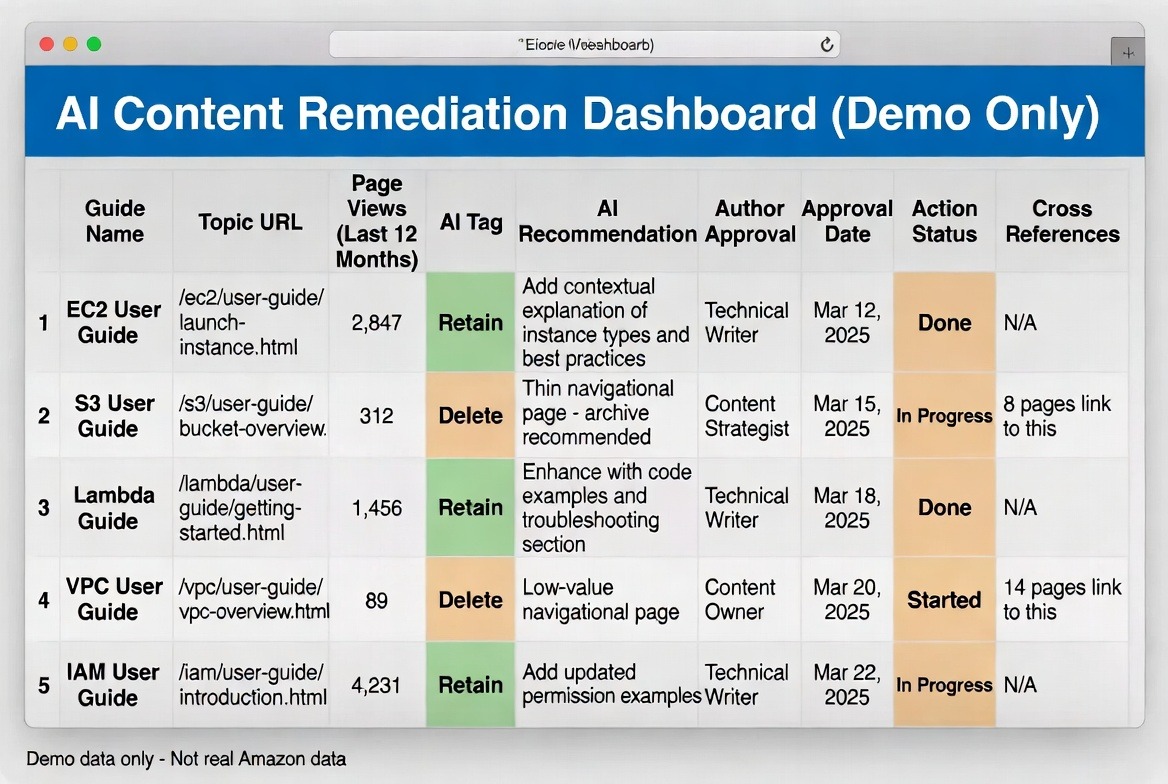
Deep Content Performance Analysis
- Analyzed how customers were engaging with pages across user guides.
- Connected performance data with SEO signals to identify pages that were not serving as authoritative content.
- Established that faux landing pages were hurting both user experience and search performance.
Building & Refining the AI Model
- Partnered with a Data Scientist to build an AI classification model.
- Wrote and iterated on hundreds of AI prompts, tested multiple approaches, and added rich examples.
- Overcame initial low accuracy (<50%) caused by wide content variations by focusing on structural signals, word count thresholds, and topic-specific patterns.
- Defined “faux landing page” criteria through extensive testing across different topics (it was not one-size-fits-all).
From Detection to Intelligent Recommendations
Main Goal: Go above and beyond just flagging pages and vanity metrics
- For low-performing pages: Tag for deletion (with cross-reference analysis to prevent broken links) unless the technical author strongly objects.
- For high-value, well-performing pages: Suggest meaningful enhancements with AI-generated contextual content based on surrounding sections in the guide.
What Really Matters
- Successfully identified and helped remediate hundreds of faux landing pages across targeted user guides.
- Writers were able to make confident decisions — archiving low-value pages and enriching high-value ones.
- Delivered measurable improvements in content quality, customer experience, and SEO performance.
- Received strong feedback from technical writers on the usefulness and actionability of the reports.
This project taught me that real impact comes from going beyond dashboards and metrics. The most valuable work happens when you connect performance data to customer needs and then build intelligent systems that answer “So what? What should I do about it?” for content creators. Thoughtful prompt engineering, iterative testing, and close collaboration with writers and data scientists are essential to turning AI from experimental to truly operational.
AI Prompt Engineering & Iterative Model Refinement • Content Performance Analysis & SEO Insight Translation • Building Actionable AI Recommendations • Cross-Functional Collaboration (Data Science + Content Strategy) • Process Innovation & Writer Enablement • Turning Complex Data into High-Impact Actions • Content Quality Classification & Remediation