The Deeper Question for Content Leaders Are We Building Websites for Humans, Assistants, or Revenue Agents?
The Spark
As someone who has spent the last decade building and governing large-scale marketing and technical websites in enterprise cloud environments, I’ve been asking a deeper question: "Are we still building websites for humans who click through pages, or for assistants that summarize them—or are we ready for the revenue agents that will soon research, compare, negotiate, and even execute purchases on behalf of buyers?"
Most enterprise marketing sites still chase clicks that buyers no longer make. The winners in 2026 aren’t just optimizing for AI answers—they’re designing digital experiences that autonomous revenue agents can act on directly.
A few years ago, the conversation was simple: optimize your website for search engines so humans can find it. Then AI assistants arrived, and the goal shifted to getting cited in generative answers. Today, that conversation already feels outdated.
"The data in 2026 makes the shift undeniable"
The Evolution
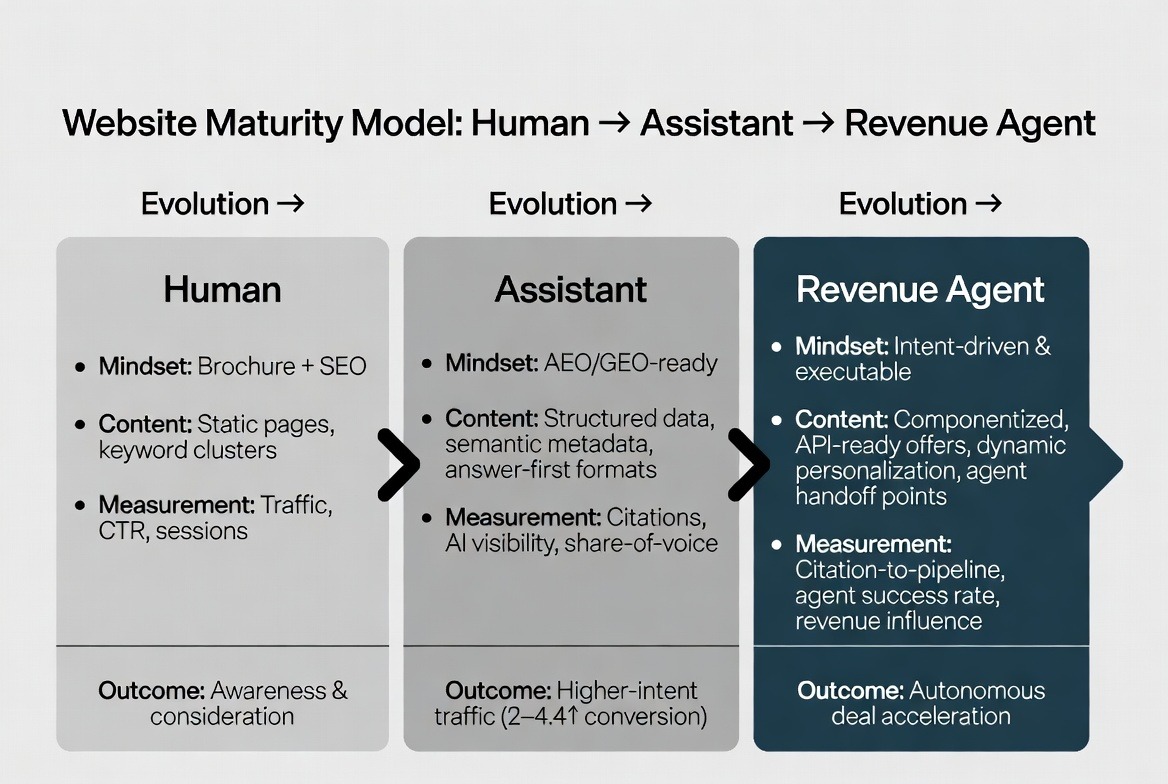
For decades, marketing websites were built for human journeys: keyword-optimized pages, clear navigation, compelling CTAs, and session-based analytics. Success was measured in traffic, bounce rates, and form fills.
That world is fading fast. Gartner predicted in 2024—and the trend has accelerated—that traditional search engine volume will drop 25% by 2026 as buyers shift to AI-powered tools. Zero-click searches now account for 64.82% of all Google queries (up from ~50% in 2019), with AI Overviews pushing many informational and even commercial searches to resolve entirely on the SERP.
Organic traffic is no longer the primary signal of success. Yet most enterprise sites are still structured like digital brochures—static pages designed for human scrolling and clicking.
We’ve adapted. Answer Engine Optimization (AEO) and Generative Engine Optimization (GEO) have moved from buzzwords to boardroom priorities. According to Conductor’s 2026 AEO/GEO Benchmarks Report, 94% of enterprise brands plan to increase AEO/GEO investment this year, and 97% already report measurable positive impact on the marketing funnel.
HubSpot’s 2026 State of Marketing Report shows AI-referred traffic, while smaller in volume, converts 3× better than traditional search and drives leads from LLMs up 1,850% in some cases. Buyers arriving via AI tools are further along in their decision-making and more intent-driven.
The playbook here is clear: structured content, semantic metadata, authoritative E-E-A-T signals, and formats that AI engines love to cite. Many teams have made this leap. But it’s still fundamentally reactive—we’re optimizing so assistants can answer questions about our products.
The deeper question is what happens next, when the AI doesn’t stop at answering.
Agentic AI—autonomous systems that don’t just retrieve information but act on goals with reasoning, planning, and tool use—is moving from sci-fi to reality. McKinsey calls this “agentic commerce,” where AI agents handle discovery, comparison, negotiation, and even transaction completion within chat interfaces. PwC describes it as a complete restructuring of the retail funnel.
Early case studies already show the revenue impact:
- Retail brands using agentic personalization (e.g., Walmart’s multi-agent Trend-to-Product system or AI shopping agents at Samsung and AVON) are seeing higher conversion rates, increased average order value, and faster purchase cycles.
- In B2B and enterprise contexts, AI agents are already orchestrating campaigns, nurturing leads, and closing pipeline with minimal human intervention.
For marketing websites, this means a fundamental redesign: from citable content to executable architecture.

This isn’t theoretical. Teams that treat their website as infrastructure for agents—using scalable taxonomies, real-time personalization engines, and machine-readable action triggers—will capture value long after the human buyer has stepped away.
Website Maturity Model
Why Most Marketing Teams Are Missing the Revenue Signal
Just as the State of Docs 2026 report highlighted the attribution blind spot in technical documentation (88% of buyers say docs influence purchases, yet most teams can’t track it), the same gap exists for marketing websites. AI citations rarely flow into CRM pipelines. Traditional analytics stop at the click that never happened.
Conductor’s data shows AI referral traffic is still only 1.08% overall (2.8% in IT/enterprise segments), but the conversion quality is dramatically higher. The brands winning are the ones measuring citation-to-revenue instead of just traffic.
How to Start Building Revenue-Agent-Ready Sites Today
The good news? You don’t need to rip everything out. Four practical moves drawn from what’s already working at enterprise scale:
- Treat taxonomy and semantic metadata as your new sales engine. Move beyond basic schema markup to intent-rich, agent-readable structures that let AI agents understand goals, constraints, and verification steps.
- Componentize content for execution, not just reuse. Single-source modules that can be dynamically assembled into personalized offers, comparison tables, or even agent-friendly “buy now” flows.
- Build closed-loop attribution that follows the agent. Track not just visits but downstream pipeline influence—whether the citation led to a deal closed days or weeks later.
- Design explicit agent handoff points. Clear, machine-readable signals (pricing APIs, configurators, negotiation endpoints) that tell autonomous systems “you can act here.”
What I’m Still Exploring
The shift to revenue agents raises bigger questions about governance, ethics, and brand control. How do we maintain trust when an AI agent is negotiating on behalf of our buyers? What does “brand voice” mean when the primary consumer of our content is another AI system?
Skills & Perspectives This Represents
I don’t have all the answers yet. But I’m convinced the content leaders who thrive in 2026 and beyond won’t just optimize websites for visibility—they’ll architect them as active participants in autonomous revenue cycles.
I’d love to hear where you’re seeing this evolution in your own work. What signals are you tracking? What experiments are you running? Drop a comment or connect on LinkedIn—I’m always up for the conversation.