Optimizing AWS Technical Content Strategy AWS Blogs vs Technical Documentation
Defined and led the enterprise-wide content strategy and governance framework for AWS Technical Blogs and Technical Documentation
Established clear differentiation, decision frameworks, content placement criteria, lifecycle management, and search optimization.

The Challenge
AWS’s technical content ecosystem had grown organically into a rich but fragmented landscape. At its core were two complementary yet distinct platforms: the authoritative AWS Technical Documentation and the dynamic AWS Technical Blogs (spanning 34 English channels + 15 language editions).
Over time, the absence of a unified strategy created five interconnected challenges:
- No comprehensive mapping of how technical content was distributed between blogs and documentation
- Limited insights into customer navigation between the two platforms
- No structured guidelines for deciding content placement
- Inconsistent metadata, tagging, and organization
- Weak lifecycle management and feedback mechanisms
- These gaps caused content duplication, diluted search authority, and made it harder for both customers and AI systems to find the right information.
I approached this engagement with a builder mindset: design the strategy from first principles so it could scale sustainably and empower existing teams rather than adding bureaucracy.
Brought in as an external content consultant to lead and define the overall strategy, my role was to create the future-state operating model for AWS technical content platforms.
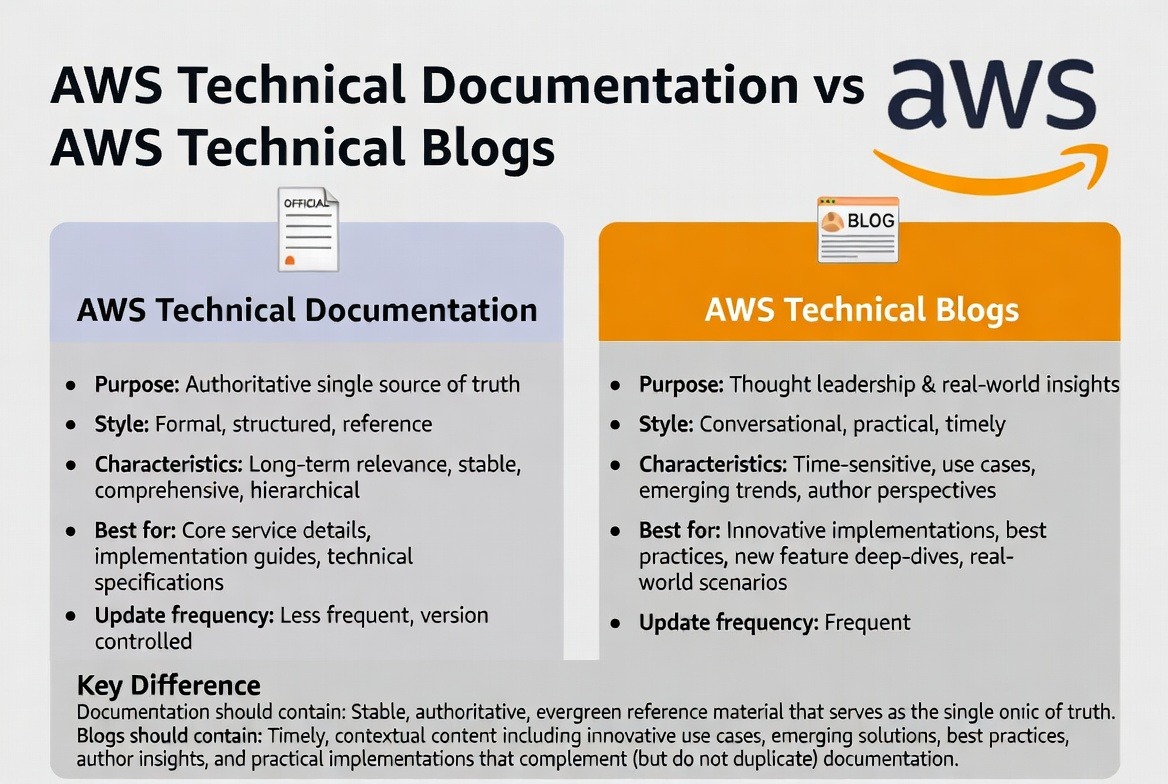
"The Strategy Architect
Technical Documentation Standards
Authoritative, structured, long-term reference material with hierarchical organization and strict accuracy standards.
Technical Blog Standards: Flexible, timely, thought-leadership content focused on real-world use cases and emerging solutions.
Content Strategy Best Practices: Clear differentiation, data-driven decisions, robust metadata, feedback loops, and full lifecycle governance.
Actionable Insights: Metrics, Feedback & Search Impact
I designed a unified measurement and feedback framework that gave stakeholders visibility they previously lacked.
Key Metrics for Both Channels
- Usage patterns and search analytics
- Content performance (views, dwell time, engagement)
- User journey mapping and content overlap analysis
Competitive Analysis
Leading tech companies (Google, Microsoft, Stripe, etc.) maintain strong separation between documentation (single source of truth) and blogs (dynamic & contextual), improving both customer experience and search performance.
Key Terms and Definitions
- Technical Documentation: Stable, authoritative reference.
- Technical Blog Post: Timely, contextual, author-driven content.
- Content Lifecycle: Planning → Creation → Review → Publishing → Optimization → Retirement.
Performance Monitoring & Data Strategy
Interim proxy metrics + phased roadmap to full analytics integration.
Customer Feedback Systems
- Short-term: “Was this helpful?” quick wins
- Long-term: Integrated feedback loops and voice-of-customer analysis
Key Questions to Address
How does this impact critical Search (SEO + Generative AEO)?
Without clear differentiation, AWS content was fighting against itself in search results. Overlapping blogs and documentation diluted topical authority and fragmented customer journeys.
In the era of generative AI, the impact was even greater. RAG systems and answer engines (ChatGPT, Perplexity, Grok, etc.) struggle to identify the authoritative source when similar content competes without clear hierarchy or metadata signals.
The frameworks I defined gave both traditional search engines and AI systems the strong signals they needed:
- Documentation = authoritative, evergreen primary source
- Blogs = timely, contextual, thought-leadership content
How should the content placement criteria & decision framework look like?
- Documentation Criteria: Long-term relevance, broad applicability, core functionality, stable reference.
- Technical Blog Criteria: Time-sensitive, specific use cases, innovative implementations, and emerging trends.
I created a practical decision tree and guiding questions to help writers make consistent placement decisions in real time.
How should the content lifecycle management & governance look like?
- Define Data-driven maintenance and retirement guidelines
- Define structured feedback mechanisms
- Assign clear roles, responsibilities, and regular review cadence
- Design phased implementation roadmap (quick wins → full analytics)
What Really Matters
The strategy document I authored became the foundational reference for optimizing AWS’s technical content ecosystem. It delivered the first clear guidelines for content placement, measurable success criteria, and a practical implementation roadmap. The framework is now guiding writers and leadership toward reduced duplication, stronger search performance, and better AI readiness.
Even at AWS scale, clarity of purpose and simple decision frameworks are the most powerful levers. When technical content teams have clear criteria, supporting metrics, and feedback systems, content shifts from a potential liability (self-competition in search) into a true strategic asset — especially in an AI-first world.
Enterprise Content Strategy & Governance at Scale • Technical Documentation vs Technical Blog Differentiation • Content Placement Decision Frameworks • Content Lifecycle Management & Retirement • Data Strategy, Analytics & Customer Feedback Systems • SEO & Generative AEO Optimization • Search Authority & Content De-duplication • Cross-Stakeholder Alignment & Amazon 6-Pager Narrative Style