From Outdated Content to Proactive Freshness
Delivered the foundation for operationalization - Freshness thresholds, evergreen content policies, and archival strategies that drive sustained improvements in content accuracy, relevance, and customer trust
Empowered technical writers and documentation managers with actionable content lifecycle insights

The Challenge
AWS customers were experiencing frustration and loss of trust due to outdated content in technical documentation. This directly impacted their ability to complete tasks effectively.
Key pain points identified through customer feedback included:
- Frequent mentions of outdated information hindering user workflows.
- Negative sentiment associated with stale content.
- A consistent volume of feedback highlighting this issue.
Outdated content also hurt discoverability — pages that were no longer accurate ranked lower in internal search results, making it harder for customers to find the most relevant and up-to-date information.
While the challenges were clear, a critical barrier existed: the absence of metrics and KPIs to measure content freshness. Writers and technical documentation managers had no clear, scalable tools to track when content was created, updated, or became stale. This prevented proactive maintenance of documentation accuracy and relevance.
Building on my prior work leading a data-driven archive recommendation initiative, leadership selected me to own and drive the development of the Freshness metric within the Content Advisor dashboard.
I took a structured, phased, and collaborative strategy that combined foundational research, stakeholder alignment, and iterative development
"The Freshness Champion"
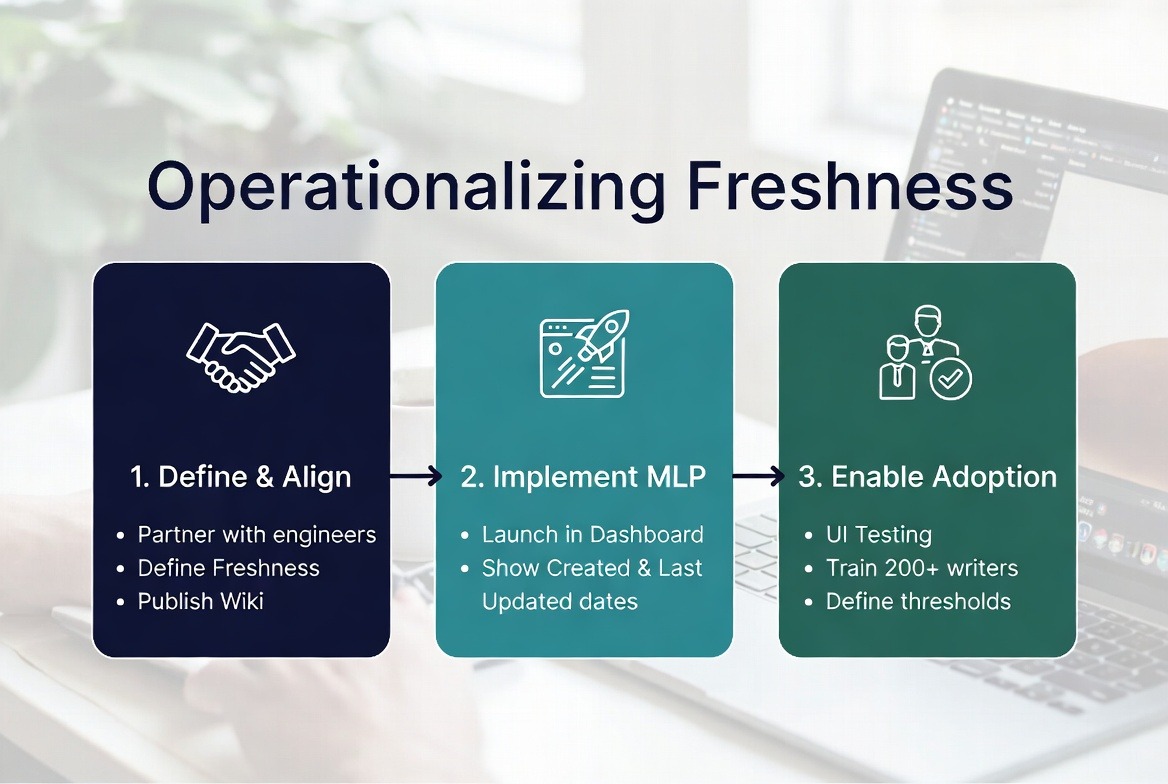
Define and align on Freshness requirements
- Partnered with the metadata team to define content freshness metadata and establish a clear, shared definition of what “Freshness” meant in the context of AWS documentation.
- Clearly defined evergreen content (content that remains relevant for extended periods without frequent updates) versus time-sensitive content.
- Published the Freshness Wiki to establish transparency, alignment, and comprehensive documentation.
Implement a phased development approach - (Minimum Lovable Product)
- Launched the MLP of the Freshness metric in the Content Quality Dashboard, providing a reliable view of “Created” and “Last Updated” dates across all AWS documentation.
- This gave writers immediate, actionable visibility into content lifecycle status.
Enable adoption through stakeholder support
- Conducted extensive UI testing to validate data accuracy and relevancy.
- Led stakeholder training sessions and created a scalable process for metric adoption.
- Partnered with engineers to define thresholds, assess risks, and ensure the metric was robust and trustworthy.
What Really Matters
The MLP of the Freshness metric was successfully launched.
Key outcomes include:
- Strong adoption: The dashboard saw high engagement from writers and documentation managers.
- Consistent usage: Writers returned to the tool regularly for content lifecycle insights.
- Improved visibility: Writers now have reliable “Created” and “Last Updated” dates, enabling better content lifecycle tracking.
At AWS scale, even small improvements in visibility can create an outsized impact. Giving writers actionable, data-driven insights transforms content quality from a manual effort into a sustainable, proactive practice. This project reinforced that strong metrics + actionable insights + cross-functional collaboration (especially with the metadata team) + clear documentation are the foundation for maintaining customer trust at scale.
Content Lifecycle Strategy & Metrics Design • KPI Development & Operationalization • Dashboard Product Development (MLP) • Cross-Functional Leadership • Stakeholder Training & Enablement at Scale • Wiki Creation & Knowledge Management • Data-Driven Content Governance • Technical Documentation Quality Improvement